
On Renumbering
And How We Feuded Before the Internet

The “younger set” is always curious about how we did things back in olden days. If you wanted to be snarky, or express your half-baked, ignorant, uninformed opinion—and there was no internet—what were you supposed to do?
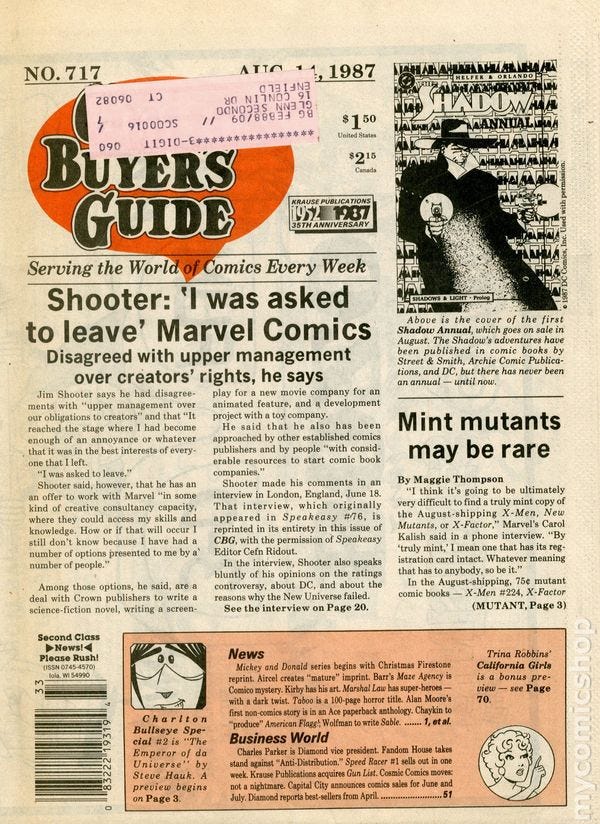
For those of us in comics, luckily, we had letters pages in our own comics. But more importantly, for a public square, if you will, we had the letters page in something called The Comics Buyer’s Guide, a weekly newspaper published by Krause Publications in Iola, Wisconsin (with one stop light amid endless cornfields), edited by Don and Maggie Thompson.
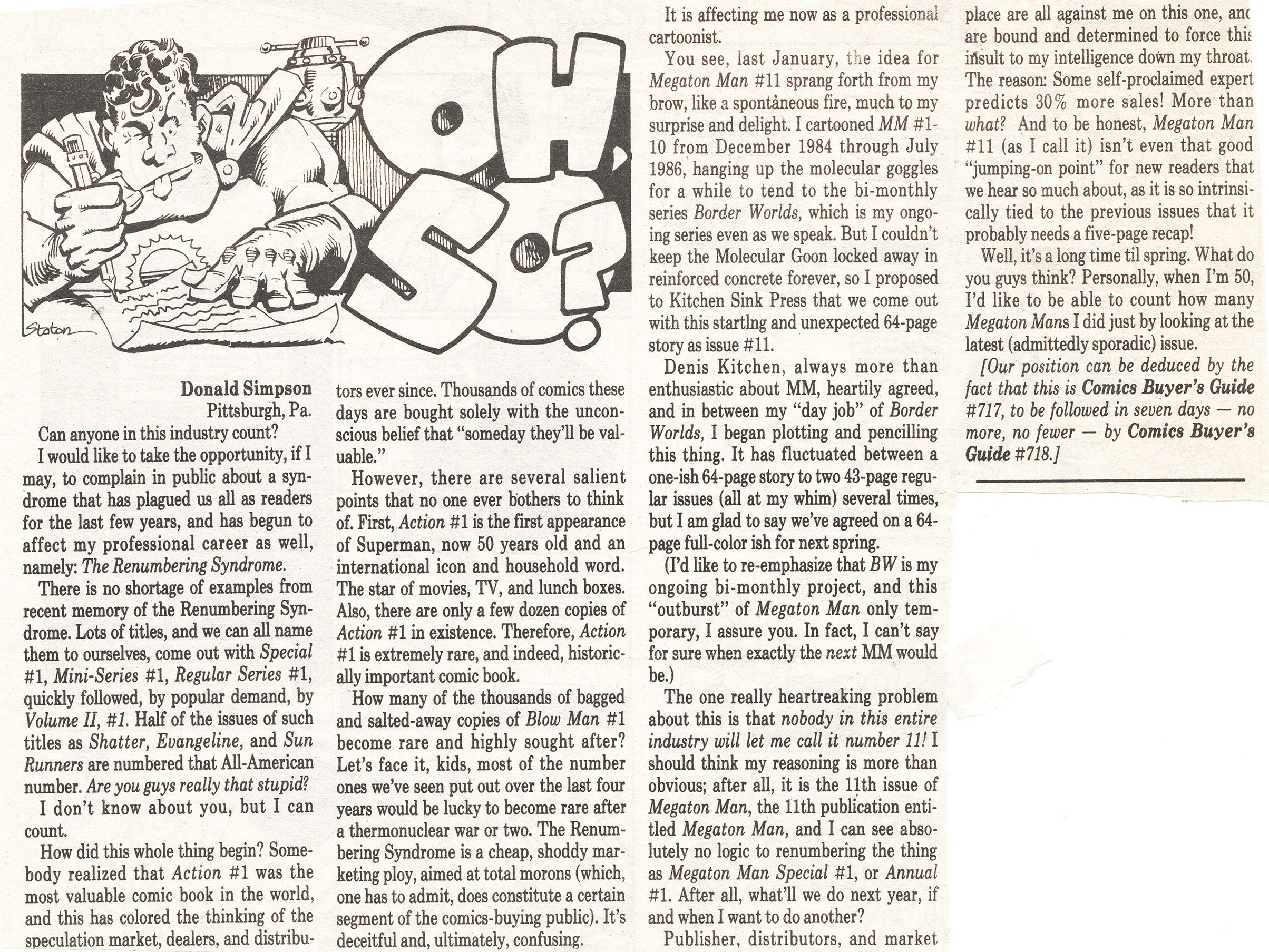
An untypical example that it may be, I wrote to Don and Maggie with my grievances concerning the numbering of Megaton Man #11, and they chose to lead off the letters column with my missive in the August 14, 1987 issue. The column, incidentally, featured a masthead drawn by E-Man artist Joe Staton—this was big time stuff.
Donald Simpson
Pittsburgh, PACan anyone in this industry count?
I would like to take the opportunity, if I may, to complain in public about a syndrome that has plagued us all as readers for the last few years, and has begun to affect my professional career as well, namely: The Renumbering Syndrome.
There is no shortage of examples from recent memory of the Renumbering Syndrome. Lots of titles, and we can all name them to ourselves, come out with Special #1, Mini-Series #1, Regular Series #1, quickly followed, by popular demand, by Volume II, # 1. Half of the issues of such titles as Shatter, Evangeline, and Sun Runners are numbered that All-American number. Are you guys really that stupid?
I don’t know about you, but I can count.
How did this whole thing begin? Somebody realized that Action #1 was the most valuable comic book in the world, and this has colored the thinking of the speculation market, dealers, and distributors ever since. Thousands of comics these days are bought solely with the unconscious belief that “someday they’ll be valuable.” However, there are several salient point that no one ever bothers to think of. First, Action # 1 is the first appearance of Superman, now 50 years old and an international icon and household word. The star of movies, TV, and lunch boxes. Also, there are only a few dozen copies of Action # 1 in existence. Therefore, Action # 1 is extremely rare, and indeed, historically important comic book.
How many of the thousands of bagged and salted-away copies of Blow Man #1 become rare and highly sought after?
Let’s face it, kids, most of the number ones we’ve seen put out over the last four years would be lucky to become rare after a thermonuclear war or two. The Renumbering Syndrome is a cheap, shoddy marketing ploy, aimed at total morons (which, one has to admit, does constitute a certain segment of the comics-buying public). It’s deceitful and, ultimately, confusing.
It is affecting me now as a professional cartoonist.
You see, last January, the idea for Megaton Man #11 sprang forth from my brow, like a spontaneous fire, much to my surprise and delight. I cartooned Megaton Man # 1-10 from December 1984 through July 1986, hanging up the molecular goggles for a while to tend to the bi-monthly series Border Worlds, which is my ongoing series even as we speak. But I couldn’t keep the Molecular Goon locked away in reinforced concrete forever, so I proposed to Kitchen Sink Press that we come out with this startling and unexpected 64-page story as issue #11.
Denis Kitchen, always more than enthusiastic about MM, heartily agreed, and in between my “day job” of Border Worlds, I began plotting and penciling this thing. It has fluctuated between a one-ish 64-page story to two 43-page-regular issues (all at my whim) several times, but I am glad to say we’ve agreed on a 64-page full-color issue for next spring.
(I’d like to re-emphasize that BW is my ongoing bi-monthly project, and this “outburst” of Megaton Man only temporary, I assure you. In fact, I can’t say for sure when exactly the next Megaton Man would be.)
The one really heartbreaking problem about this is that nobody in this entire industry will let me call it number 11! I should think my reasoning is more than obvious; after all, it is the 11th issue of Megaton Man, the 11th publication entitled Megaton Man, and I can see absolutely no logic to renumbering the thing as Megaton Man Special #1, or Annual #1. After all, what’ll we do next year, if and when I want to do another?
Publisher, distributors, and marketplace are all against me on this one, and are bound and determined to force this insult to my intelligence down my throat.
The reason: Some self-proclaimed expert predicts 30% more sales! More than what? And to be honest, Megaton Man #11 (as I call it) isn’t even that good “jumping-on poirit” for new readers that we hear so much about, as it is so intrinsically tied to the previous issues that it probably needs a five-page recap!
Well, it’s a long time until spring. What, do you guys think? Personally, when I’m 50, I’d like to be able to count how many Megaton Mans I did just by looking at the latest (admittedly sporadic) issue.
Don and Maggie replied, in their usual equivocating manner:
[Our position can be deduced by the fact that this is Comics Buyer’s Guide #717, to be followed in seven days—no more, no fewer—by Comics Buyer’s Guide #718.]
More Context
(And if you’ve already read my last dozen posts, feel free to skip):
What’s interesting about my letter is that during the year, my story arc for Megaton Man #11, which had been outlined in a four-page typewritten plot in January 1987 and greeted enthusiastically by editor Dave Schreiner and tacitly accepted for publication as a black-and-white by publisher Denis Kitchen shortly thereafter, had morphed into two color issues.
How all this unfolded, I can’t say; I have no documentation on it. I assume it was only discussed over the phone occasionally as I continued in those months working on Border Worlds #5, #6, and #7.
By November, I had in mind four issues—Megaton Man #11 through #14—and since, in the meantime, I had suspended Border Worlds, anyone with half a brain might have guessed I was on my way to resuming the series indefinitely—that #15, #16, #17 and beyond might be forthcoming, eventually, with not much encouragement.
Denis Kitchen, however, incensed that I had resorted to freelancing for DC Comics, and perhaps assuming I was lost forever, wrote a nine-page diatribe calling me a hack, a sellout, a jerk, a punk, a spoiled holdout trying to renegotiate the terms of my contract and threatening a work stoppage, a traitor to my readers and himself personally for killing two series without offering any reason at all—simply because I had grown tired of them—and a quitter.
I stated that continuing the numbering of Megaton Man with #11, was important for me to feel as though I were continuing an organic, lifelong work. Denis, however, declared that it wasn’t important at all, and even though he agreed it was a stupid, transparent, and feckless marketing gimmick, claimed my objections were mere “prima donna posturing.”
Will Eisner’s The Spirit, when Kitchen Sink Press took it over from Warren Magazine, maintained the same sequential numbering; Robert Crumb’s Mr. Natural appeared in three issues over seven years without being renumbered; the anthologies Snarf and Dope Comix maintained numbering over long stretches, sometimes years, between issues—and this was at Kitchen Sink Press alone. Xenozoic Tales would maintain its numbering, again with sometimes a year or more between issues.
Yet Denis claimed that it was unprecedented for any series to maintain its numbering, and that Megaton Man #11 absolutely demanded to be renumbered.
A year later, Denis essentially decreed that henceforth, any new Megaton Man comics had to have a #1 on the cover, presumably follow a Megaton Man vs. Fill-In-the-Blank #1—with Fill-In-the-Blank being whatever appeared to him as “hot” in comics at the moment, and therefore the selling point of the book—with the Megaton Man cast and storyline reduced to bit players somewhere in the background.
At which, one has to ask—what do you need Megaton Man at all for? What do you need me for? How is this even creator-owned comics at all?
And if you think these things are going to sell, why not offer a livable page rate?
Not to mention, this was completely the opposite advice of his own editor, Dave Schreiner, who wrote, “I’m glad you’re thinking of bringing [Megaton Man] back … I think it’s about time you stopped viewing the character as merely your vehicle to boff on the comics biz, and … as simply the comic relief with his ‘silly fight scenes.’ What you have built, quite possibly unintentionally, is a very likeable character that people seem to care about …” Dave also felt that a certain amount of superhero parody, while probably “obligatory,” was “kind of a drag.”
Those who side with Denis—an important figure in the history of comics, to be sure, and one who comes across as reasonable and well-spoken even when it’s not apparent that he’s exaggerating, plausibly denying, and conveniently forgetting pertinent facts—seem to think that the renumbering of Megaton Man was simply a marketing gimmick—good or bad—and to which I should have easily found a workaround.
And that Megaton Man was the all-purpose parody that should easily slot into “fill-in-the-blank.”
Insecure egotist that I am, I tell those people: Go read The Tick.
The fact is, I tried it Denis’s way and found it completely unworkable—just as I had warned.
Threading the needle—telling the stories I wanted to tell and at the same time conforming to a #1 schema that was never imposed on any other so-called independent creator of the era—proved impossible for me.
In retrospect, Megaton Man #11, #12, #13, and #14 would have led more swiftly and easily to #15, #16, and #17—and in less time than I had predicted; I didn’t want to over-promise.
The unwarranted verbal abuse of the nine-page letter was terribly traumatic and left lasting damage. It was obvious to me that Denis hated my guts—when I had been the most dependable, consistent, and consistently profitable creator he ever would discover. From that point forward, I could do nothing right, and I was even blamed for the chaos his imposed renumbering had made of my IP.
In 1991, Denis wrote to ask,
Will there be additional Border Worlds? Bizarre Heroes? Pteranoman? Megaton Man? Ms. Megaton Man? Have you defected totally to Fantagraphics or have you other plans after King Kong and Wendy? We should talk sometime about what plans you have with regard to KSP or ideas you have which are up in the air.
Essentially, was I planning any #2s to follow up on all the #1s I had generated?
You’ve got to be kidding.
All I had wanted to do with Megaton Man #11 was the next issue of Megaton Man. I never wanted to do all those stupid, senseless, incomprehensible, confusing #1s.
Even if nobody else can see it, it’s clear to me what a decisive and unfortunately tragic moment this was. I had created ten issues of Megaton Man, seven issues of Border Worlds—and now, having learned my lesson—that the market didn’t want a science-fiction melodrama with a female protagonist—I was ready to return to Megaton Man. I had my second wind; I had devised—and sought and received the editor’s approval—for a character-driven direction that could have sustained a series for years.
The unnecessary and unwelcome complication of having to fit the #1 schema—The Return of Megaton Man #1 sold only slightly better, predictably, than #2 and #3, and thereafter, the one-shots sold about the same—and the torrent of verbal abuse accompanying it had served only to derail my imagination, and the toxic and hateful energy emanating from Kitchen Sink Press became oppressive to the point of complete dysfunction.
I happen to believe that a black-and-white Megaton Man #11 through #14, along with second printings of Megaton Man #1 and #2, long sold out, would have laid the foundation for a long and productive run—one that wouldn’t have required nine-page letters or acrimony or angst at all.
Instead, Kitchen Sink Press became a malignant cancer that had to be removed from my career so that Megaton Man—and everything else—could move forward. Even so, it took time to recover—years before I felt the same fondness for the characters, even longer before I could get back in touch with the story possibilities Dave had endorsed.
I never felt the same fondness for Denis or for Kitchen Sink Press ever again.
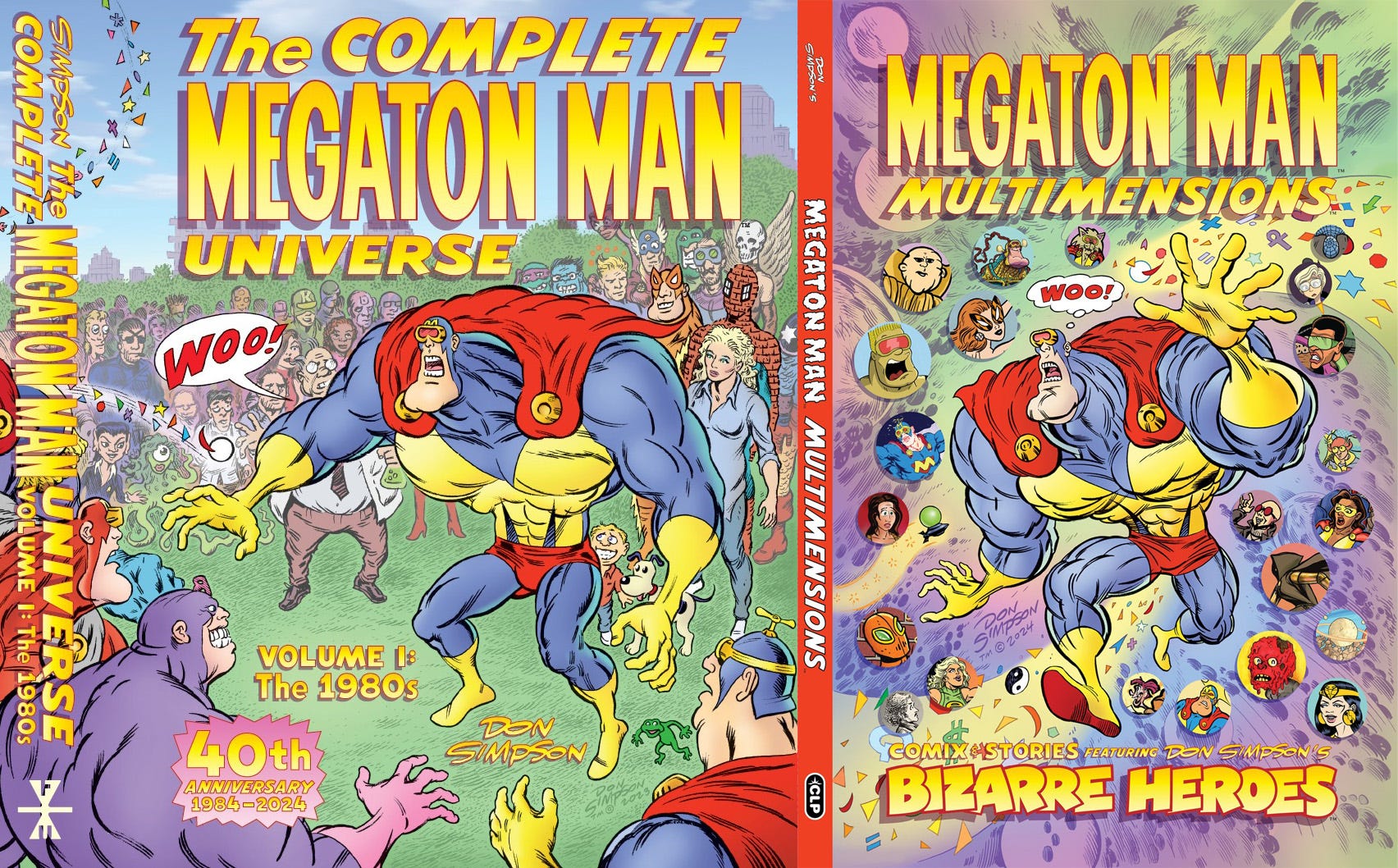
Preorder The Complete Megaton Man, Volume I: The 1980s
Learn about Megaton Man: Multimensions