
Dog vs. God
Michelangelo, McFarlane, and Other Mismatched Misuses of the Marvel Method

Yesterday’s clickbait du jour, at least according to my algorithm, is some video in which Todd McFarlane claims he could sell a buttload of comics scripted by his dog as long as it was drawn by Michelangelo. Apparently, this has set off a controversy among the handful of comics fans born the day before yesterday.
In case you’re just tuning in: The story vs. art, word vs. picture, text vs. visual debate has been a staple comic book convention panel topic for the past half-century. It’s as venerable as the “Women in Comics” panel, a mainstay back in the twentieth century, when there were only a handful of female professionals in comics, and even fewer attendees at the typical con. “Why aren’t there more women creators in comics? Why not more female readers?”
As cons have somehow transmuted into shows over recent decades, the proportion of female creators and fans have risen; shows where diversity is in the majority and nearly-dead straight white males (like me) are barely represented have splintered off and formed their own subculture and economy. I’ve attended a few of those ‘zine shows, and they are far more interesting than the mainstream celeb photo-op IP fandom fests that pass for comic-centric cons these days.
What’s amazing is that the drawing vs. writing question can still get eyeballs this late in the day. It’s as nearly as effective a troll as posting “Rob Liefeld can’t draw feet!” Just type, post, and watch the sparks fly. (“But you can’t deny the energy Rob brought back to the moribund form …”)
Zzzzzz.
What I find interesting is the example Todd used. Michelangelo Buonarroti (1475-1564)—fresco painter, sculptor, architect—generally tops surveys in terms of name recognition and high regard as the greatest artist of all time. No doubt his virtuosity in the human figure based on an intense study of anatomy, mastery of perspective, and even inventive pastiching of ancient Greco-Roman building forms ranks him as one of the singular geniuses of the Renaissance along with Leonardo Da Vinci—and one of the greatest artists of all time.
He even wrote florid sonnets—poetry, for cryin’ out loud—so he was no slouch in the verbal department, either.
Todd seems to regard Mickey B. purely in terms of his virtuoso mastery of visuals, divorced from content—the way most comics fans view “really cool” eyeball-catching art dancing to the trite, banal cliches of the superhero genre.
Let me just pause here to say Todd has always been kind to me—I drew a Meddler pinup in Spawn #16 back in the day, and chronicled his boxer-shorts debate for Hero Illustrated. I even recast the Toddmeister as the winner—a revision of history that infuriated the real winner, Peter David, to no end.
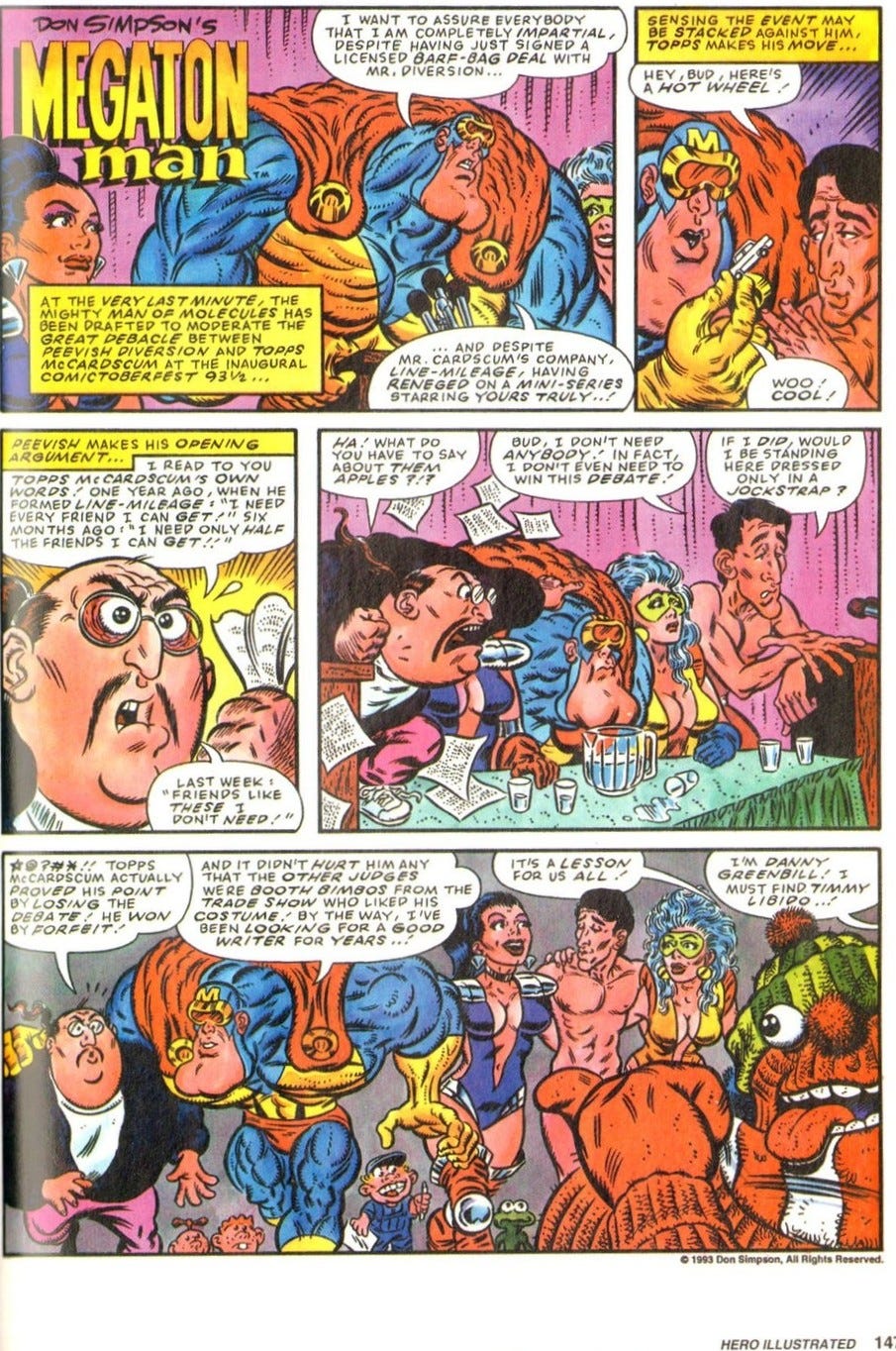
That very debate (I was in the audience) had been about words vs. pictures—yawn!—and Todd’s gambit of shedding everything but his boxers went over like a lead balloon. It was the culmination of what had been a series of rants by David in The Comics Buyer’s Guide accusing the breakaway republic of Image of being form over content—pretty, shiny pictures and clever page layouts devoid of ideas.
I’m not sure the avowed master of the tie-in novel (David) ever had a deep thought in his life beyond what a snotty 14-year-old regarded as cool—which is maybe why a shallow TV writer named Harlan Ellison was his literary hero. But he had a point—even the Cartoonist Kayfabe guys, who grew up on “Image, Year One” recognized the superficiality of those early Image comics.
I recall the late Chris Yambar’s self-published Substance Comics—just to show the backlash to Image wasn’t just one letterhack at the CBG. It was fairly widespread—until the Image boys started hiring everyone in sight, including me.
The Image guys had a point, too—particularly “Name Withheld,” the pseudonym of Erik Larsen, who more deftly debated David in the CBG letter column. That being: The typical mainstream penciler, working in the so-called Marvel method of plot-pencils-script, could probably dialogue their pages as capably as most of the interchangeable scribes aping Stan Lee—including Peter David.
But, let’s be honest: If you ever read a comic book drawn by Jack Kirby or Steve Ditko scripted by Stan Lee—and compared it to a comic book Jack or Steve dialogued themselves—you can see immediately that Stan had a knack for verbiage that Jack and Steve simply never cultivated.
John Byrne and Erik Larsen, when they took over scripting of books they were penciling, did cultivate a certain craft for verbiage. But there are others—Frank Cho comes to mind—who never did.
To their credit, the Image guys were smart enough to call upon some of the best writers in the business to bolster their fledgling IPs. Todd got Neil Gaiman, and just about every other founder fought over the services of Alan Moore—wresting him away from Rick Veitch, Steve Bissette, and Jim Valentino—which is why the 1963 Annual never happened. Jim Lee, apparently, had the most dough.
Which brings me to the underlying point in this flimsy debate: It’s really about power dynamics. Who controls the property, who has most influence over the outcome, who gets the toy royalties. That’s what Image was about, and why comics are (or were, at the time) a business rather than a philanthropic pursuit.
I’ve argued, quite recently, that Jim Lee’s decision to ditch the 1963 Annual and set Alan Moore to work on IP that Jim Lee exclusively controlled was not only underhanded and blatantly treacherous—I watched him insincerely promise to draw the 1963 Annual in public—but also short-sighted and an incredibly poor business decision.
After all, the 1963 Annual would not only have served as the climax to the six-issue 1963—it would have also cemented the Image Universe, elevating the value of all the founders’ discrete properties—which Alan Moore would have accomplished by-the-way. The collective could have mined those ideas for decades—and imagine what an Image Cinematic Universe would be worth today: Billions and billions.
Jim Lee, you dolt.
Getting back to Michelangelo, what I found most remarkable in Todd’s misuse of this example as a supposed form-over-content artist is that Mickey B. only happens to be the most literary-based artist in history.
The Sistine Ceiling, The Last Judgment, La Pietà, David (the Goliath-killer, not Peter)—one can hardly think of a major work by Michelangelo not derived from the most foundational literary source in western civilization.
The authors of the Bible may be almost entirely anonymous—like The Iliad and The Odyssey, the author is thought to be an entire culture rather than an individual who may have gone by the name Homer—but it is still a literary work.
Perhaps you consider it the divinely-inspired word of God. Whatever—or rather, whoever—the content provider.
Could Todd McFarlane’s dog come up with memorable stories like Adam and Eve in the Garden of Eden? The creation of man? The flood and Noah’s ark? The Book of Revelation? I’m guessing not.
These are grand themes that have become so commonplace we don’t even think of them as content. But they inspired the artists of the Renaissance and they will go on inspiring artists long after all our collectible baubles have turned to dust.
But Todd’s point is valid—he no doubt could sell a buttload of comics that were masterfully drawn and completely devoid of intellectual content. In fact, I’m pretty sure he did, and it made him a millionaire.
Moreover, if you look at the comic book industry today, such as it is—with the emphasis on covers over interiors, slabbed comics that can’t even be flipped through, and dazzling imagery with no narrative elaboration—and it’s hard to argue that form has won over content.
I’m just not convinced that Michelangelo is the best example to enlist in your argument.
I’ve always been of the opinion, when it comes to the words vs. pictures controversy: Which do you plan to do without? And why do you feel compelled to dispense with one or the other—when you don’t have to? We should be asking more from our reading and visual experiences—the most we can possibly get—not less.
I find it useful to think of words and pictures as systems of notation that can blend to varying degrees in comics. It's a complex, egg-headed theory that I'll have to blog about one these days.
Excellent, Don - good points throughout. Although "Jim Lee, you dolt" may have ruined your chances to work on the resuscitated, renewed, and revived Wasteland series, which I'm sure DC will to it eventually, once they have revamped all their other IPs!